



Technical Guide
Pallet Types:
how to Choose the Right One for Your Business
From wooden pallets to certified europallets, plastic and metal: everything you need to know to make an informed choice.
Updated: April 2026 | Reading time: ~7 minutes | Category: Guides
1. What Is a Pallet and Why Choosing the Right One Matters
The pallet, also known as a skid, is a flat platform used to support goods during transport and storage. In practice, it is the foundation of modern logistics: without it, moving large quantities of products quickly and safely would be far more costly and complex.
But not all pallets are the same. Choosing the wrong type can mean damaged goods, incompatibility with storage systems, customs issues when exporting, or unnecessarily high costs. This guide will help you navigate your options.
QUICK
A pallet is the basic unit of logistics: it allows large volumes of goods to be moved with forklifts and pallet trucks, protecting the load during transport and storage.
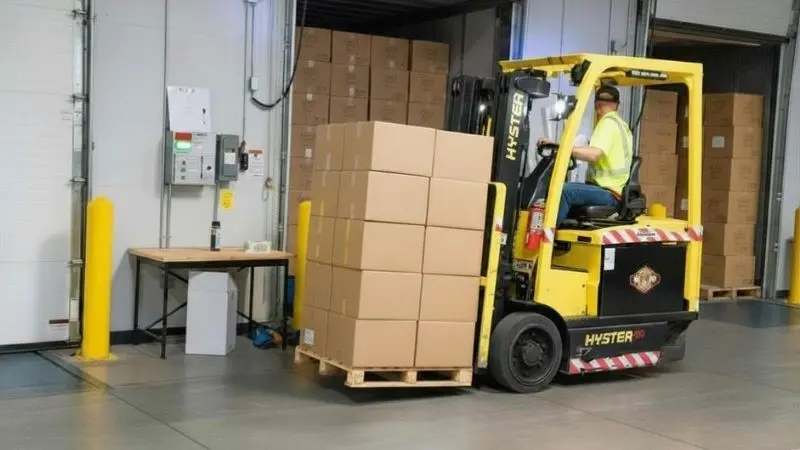
A forklift moves pallets in a logistics centre
2. Wooden Pallets: The Most Common Choice
The wooden pallet is by far the most widely used. Its popularity comes from a combination of factors: low cost, good durability, ease of repair, and compatibility with most handling systems
The classic structure has four-way entry for forklifts and two-way entry for pallet trucks, making it highly versatile. They come in various sizes, but the three most commonly used internationally are:

Standard wooden pallets in a logistics warehouse
Most Common Standard Sizes
EUR 1 — 1.200 × 800 mm
Weight: ~25 kg
Max load: 1.490 kg
Use: Near universal
Max load: 1.490 kg
Use: Near universal
EUR 2 — 1.200 × 1.000 mm
Weight: ~33 kg
Max load: 1.470 kg
Use: Common in other European markets
Max load: 1.470 kg
Use: Common in other European markets
EUR 3 — 1.200 × 1.200 mm
Weight: ~29 kg
Max load: 1.920 kg
Use: Bulky and symmetrical loads
Max load: 1.920 kg
Use: Bulky and symmetrical loads
✅ Advantages
- Low purchase cost
- Repairable if partially damaged
- Compatible with almost all handling systems
- Easy to source anywhere
❌ Disadvantages
- Flammable
- Susceptible to insect infestation
- Risk of chemical and bacterial contamination
- Not suitable for sectors with high hygiene requirements
EXPORT WARNING
If you export goods outside the European Union, wooden pallets must be treated in accordance with international standard ISPM 15 (heat treatment or fumigation). In many countries — including the USA, Australia, and China — this is mandatory. Without this treatment, shipments may be held at customs.
3. Europallet (EPAL): The European Standard
The europallet was created to meet a specific need: to establish a uniform system for international transport, allowing any logistics operator in Europe to move, store and exchange pallets without worrying about incompatibility.
The standard is defined by norm UNI-EN 13698-1 and the main version — known as EPAL 1 — follows the dimensions of the EUR 1 pallet.
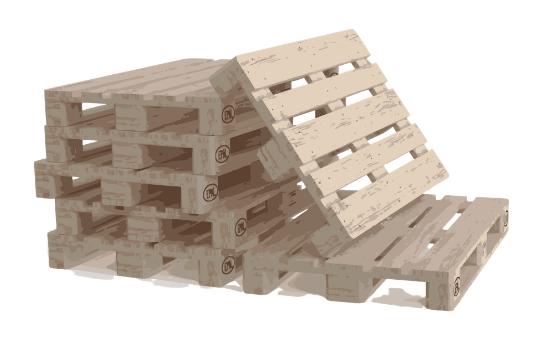
Europallet EPAL1
✓ EPAL 1 — Official Specifications
Dimensions: 1.200 × 800 mm
Weight: ~25 kg
Dynamic load: 1.500 kg
Static load: fino a 4.000 kg
Every certified europallet bears the EPAL mark stamped on all four corner blocks on the longitudinal side. This mark is not decorative: it certifies that the pallet meets the construction criteria verified by the EPAL Technical Committee, which carries out over 2,600 inspections per year in Italy.
EUR VS EPAL: WHAT'S THE DIFFERENCE?
An EUR 1 pallet meets the standard dimensions but is not necessarily certified. An EPAL 1 pallet has the same dimensions and has additionally been built to verified criteria and carries the quality mark. If you operate in contexts where construction quality matters — automated warehouses, export, inter-company exchange — always choose the certified EPAL.
Why use the europallet? Because it is designed to optimise space: its dimensions are an exact multiple of those of KLT industrial containers and standard plastic crates. This means trucks and semi-trailers are used to their maximum capacity, reducing transport costs per shipment. The europallet is also fully compatible with automatic loading and unloading systems , which require standardised dimensions and construction quality to operate correctly.
4. Plastic Pallets: Hygienic but Costly
Plastic pallets are the preferred choice for sectors where hygiene is a priority: food, pharmaceutical, and cosmetic industries. Unlike wood, they do not absorb moisture, do not rot, and can be washed with water and detergents.

Plastic pallets
✅ Advantages
- High hygiene and washability
- Non-flammable
- Resistant to mould and insects
- Longer lifespan than wood in controlled environments
❌ Disadvantages
- Higher purchase cost
- Cannot be repaired if broken
- Risk of slipping on forks in wet environments
- Deformation under very heavy loads
WHEN TO CHOOSE IT
If you work in the food, pharmaceutical, or any sector subject to hygiene regulations, the plastic pallet is almost always the obligatory choice. The higher price is offset by its durability and regulatory compliance.
5. Metal Pallets: For Extreme Loads
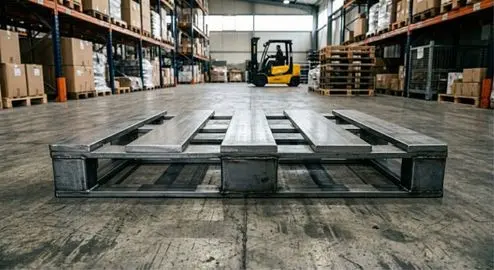
Metal pallets are not for everyone. They are designed for extreme situations: very heavy loads, aggressive environments, specific applications where wood and plastic would be inadequate. They are made from three main materials, each with different characteristics:
| Material | Features | Typical sector |
|---|---|---|
| Carbon steel | High strength, lower cost, prone to oxidation if untreated | Heavy industry, automotive |
| Stainless steel | Corrosion resistant, washable, expensive | Food, pharmaceutical, chemical |
| Aluminium | Lightweight, corrosion resistant, very expensive | Aeronautics, air freight (ULD) |
PALLETS AND CONTAINERS FOR AIR FREIGHT (ULD)
Pallets and containers used on aircraft — known as ULDs (Unit Load Devices) — fall into a separate category, governed by specific civil aviation regulations. We cover this in detail in our dedicated article: Air pallets and ULD containers: everything you need to know →
The purchase cost of metal pallets is significantly higher than other types. However, their lifespan — if properly maintained — is far superior. In the long run, the cost per use cycle can be competitive compared to alternatives that wear out more quickly.
6. Special Pallets: When No Standard Will Do
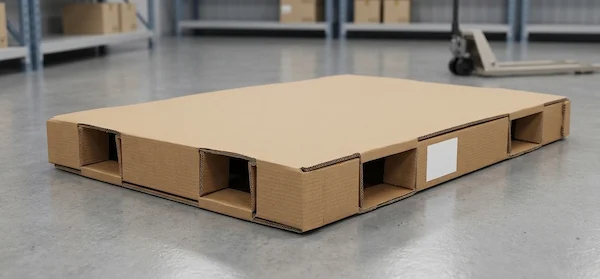
There are situations where standard dimensions or materials are not suitable for the goods being transported. In these cases, custom-made pallets or those made from alternative materials are used: reinforced corrugated cardboard, plywood, composite materials.
Flexibility is their only real advantage: they allow the handling of goods with unusual geometries, weights, or fragility that standard pallets could not accommodate adequately.
HANDLING WARNING
Non-standard pallets can cause compatibility issues with automated loading and unloading systems . Always verify compatibility with your equipment and that of your logistics partners before adopting them on a large scale.
7. Quick Comparison of Pallet Types
| Type | Cost | Hygiene | Strength | Best for |
|---|---|---|---|---|
| Wood (EUR/EPAL) | Low | Medium | Good | General use, mass distribution, export |
| Plastic | Medium-high | High | Good | Food, pharmaceutical, sterile environments |
| Metal | High | High (stainless) | Excellent | Heavy loads, automotive, aeronautics |
| Special | Variable | Variable | Variable | Oversized goods or specific requirements |
8. How to Choose: The Right Questions to Ask
There is no universally "best" pallet. The choice depends on your operational context. Here is a practical way to navigate it:
FOOD OR PHARMACEUTICAL SECTOR?
Plastic or stainless steel
Hygiene regulations require washable, non-absorbent materials. Wood should be avoided.
HEAVY LOADS OR INDUSTRIAL COMPONENTS?
Metal (steel)
For high weights or aggressive environments, metal offers strength that wood and plastic cannot provide.
GENERAL LOGISTICS OR MASS DISTRIBUTION?
Europallet EPAL 1
Universal compatibility, certified standard, optimised loading space. The safest choice in most cases.
EXPORTING OUTSIDE THE EU?
ISPM 15 treated wood
Check the requirements of the destination country. Treatment is mandatory for many non-European markets.
PRACTICAL RULE
If you have no particular hygiene constraints and operate mainly in Europe, the certified EPAL 1 europallet is the safest and most versatile choice. If you have specific requirements — food, heavy loads, fragile goods — start from those requirements to select the right material.
Sources: EPAL Italy · EPAL Europe · Standard UNI-EN 13698-1
Do you handle pallets every day?
Discover how to automate your loading and unloading operations with our dedicated systems.